Archive

Archive for the ‘Automotive’ Category

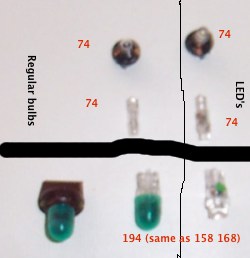
LED’s in an instrument cluster

February 27th, 2007

If you’re simply looking for raw data (numbers), skip to the bottom of this write-up. Otherwise, continue on for some background and other info.

In my previous LED writeup, I found that LED bulbs when used in a vehicle happen to use much less power than regular bulbs. In my own case, replacing the front side-markers, rear side-markers, and rear park lights (essentially, all the lights that come on with the headlights with the exception of the headlights themselves), the current draw was brought down from 2.14 amps to about 0.26 amps. This means that the LED’s used about 12% of the power. Not bad.

Next, it was time to replace the bulbs in the instrument cluster. Read more…

Sprint valve burnt because the valve was not closing

February 14th, 2007

The title says it all. For the benefit of the search engines, I should mention that this should apply to most 1.0L 3-cyl Geo Metro, Suzuki Swift, Pontiac Firefly and Chevrolet Sprints made around 1991 (89-91).

Basically I can sum it up by saying this. We had an engine that started to perform badly and over the course of 2 weeks really took a hit to the point where it didn’t even want to go over 90 km/h. It seemed like the timing was retarded, and would sputter, cough, and had terrible performance at low rpm’s. I’ve read through the teamswift.net forums often enough to know that these engines are prone to burnt exhaust valves, so we figured that was probably the cause. A compression check verified this.

We pulled off the head and took a look. Sure enough, there was a flat section where the valve wasn’t sealing any longer. Seeing’s how we had a parts car and weren’t looking to feed any more money into this one, we pulled the head from the parts car which fortunately still had 1 non-burnt valve left on it (you can guess why it became the parts car). We grabbed the good valve from the parts car and swapped it with the bad one from the current one. Since we already had the head out, we took the opportunity to lap all the valves which was probably a good thing, since most weren’t in the greatest of shape. Once it was all said and done, we oiled everything up and put the head back together.

Before bringing the head back to the car, we thought it might be a good idea to turn over the camshaft a few times just to make sure the valves were all opening and closing properly. It’s a good thing we did, because the exhaust valve we replaced wasn’t closing all the way. Read more…

From regular to LED bulbs – How much of a power savings can you expect?

October 12th, 2006

It’s a well known fact that LED’s require very little power to provide the light of a similar incandescent bulb. In automotive applications, there are situations where reducing the power draw is desired. Switching to LED’s can be helpful here. Read more…

How to increase the gas mileage of your car

September 22nd, 2006

Before I get started, this isn’t your typical “make the most of your fuel economy” article for the average person. This is geared more towards the car enthusiast… if you’re the type of person to make changes (mod) your car, this may be helpfull to you.

I’m assuming you’ve already read the typical “make the most of your fuel economy” articles, which have probably given you tips like changing your driving habits (non-aggressive driving, keeping to non-excessive speeds), keeping tire pressures up, changing spark plugs/performing general maintenance/tune-ups, buying a more fuel-efficient vehicle, keeping the air conditioning off, keeping windows up at high speeds, etc. These are all well-known “tips”, and while they do help, I’ve always looked for more. And here’s what I’ve come up with so far. Read more…

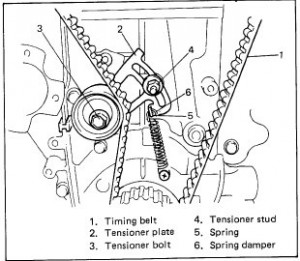
How to replace the timing belt in a 1991 Chev Sprint

September 17th, 2006

Yet another how-to that should apply to most 1989-1991 Sprints, Fireflys, Metros, and Swifts. This was done on a 1.0L 3-cylinder, so those with the 1.3L are out of luck. Unfortunately, I didn’t think to take pictures during this procedure, but I’ll try and be as specific as possible. This was not performed on a vehicle with air conditioning or power steering. If you have either of these, there may be more steps involved. Oh, and as with all vehicle work, it may be a good idea to disconnect the battery. After all, you don’t want to lose your hand/arm/life because the car tried to start at the wrong time.

Read more…

Replacing rear wheel bearings in a 1991 Chevy Sprint

September 14th, 2006

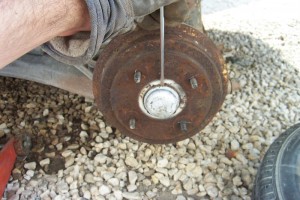
If you find yourself driving down the road and hear a “crunch crunch crunch” coming from one of the back wheels of your car, there’s a good chance you’ve got bad wheel bearings. Actually, your bearings probably went bad long before you heard the crunching, but as with many other parts, they were nice enough to make a really awful sound to let you know they were preparing to leave you stranded.

Replacing the bearings isn’t a particulary difficult job. If you’ve ever replaced the brakes in your car, you’ve probably got the ability to do the bearings. It’s a job I recently tackled, and I thought I’d share the steps I took in doing so. This was done on a 1991 Chevrolet Sprint, but the process is very likely to be extremely similar (if not exactly the same) for a 1989 or 1990 Pontiac Firefly, Suzuki Swift, or Geo Metro as well. Read more…

Key broken in the ignition of your Sprint/Swift/Metro/Firefly? Here’s how to fix it.

June 16th, 2006

An all-too-common problem in Chevrolet Sprints, Suzuki Swifts, Geo Metros, and Pontiac Fireflys occurs when the key breaks in half in the ignition. Unfortunately, almost every one of the keys created for these cars has a thin point in the key, where inevitably, at some point during the key’s life, it splits in two. If you’re lucky, it’ll break in your pocket. But more often than not, they decide to fall apart within the ignition switch. Read more…